
Descriptive Praise
By noticing and naming what kids do well, adults can help nudge them towards better behavior.

The Opponent: The Correction Trap
In the churn of busy family and classroom life, it’s so easy to find ourselves just focusing on what’s going wrong. The shoes that still aren’t on, the mysterious stickiness on every surface, the casual peer antagonism that starts before your first sip of coffee.
It can feel like we spend our days policing the little hellions in our lives, giving one correction after another:
How many times have I told you not to ___?!
Why would you do that?
Stop that right now!
No adult enjoys this pattern, but it can feel like the only way to get kids to behave. However, the drip drip drip of negativity wears us all down (and if we are being honest, does not actually do much for kid behavior in the long run). Kids start to feel like they just can’t win—so why try? Adults wonder where they went wrong and if other families and classrooms have this much yelling and scolding. And it creates constant, low level stress, with everyone secretly wishing for just one calm, mistake-free moment.
The TLDR: We easily fall into patterns of focusing on negative behavior which is hard on everyone.
The X’s and O’s: What We Attend to, Grows
Adult attention is a powerful thing. Kids crave it and will do just about anything—positive or negative—to get more of it. This truth (thanks BF Skinner!) underlies a lot of challenging kid behaviors and can help explain how we fall into the correction trap.
Think of your attention as water in a garden. When you point out every spill, every backtalk, every forgotten shoe… you’re unintentionally watering the weeds. Think of a particularly challenging kid behavior you’re dealing with at the moment. Has your pointing it out over and over made it increase or decrease? We’re betting on the former.
When you pause to notice what’s actually going right though—even a tiny moment—you’re watering the roses. You’re letting kids know what you like and want to see more of. This gives kids a clear roadmap for how to get more of that positive attention in the future which encourages more good behavior.
Positive attention to effective behaviors also changes the tone by showing kids that you do notice when they are taking steps in the right direction. This can be a powerful relationship strengthener because it increases kids’ confidence and willingness to try. It also boosts the adult’s mood and optimism to notice all of the overlooked things a kid is already doing well.
The TLDR: When you notice and name what’s going right, you encourage more of that behavior.
The Play: Descriptive Praise
Descriptive praise relies on that powerful adult attention to “shape” kids towards more of the behaviors we want to see. Descriptive praise is exactly what it sounds like—rather than vague compliments like “good job” and “nice work,” this play calls for adults to describe exactly what they notice and like in a child’s behavior.
“You started your homework without reminders.”
“You didn’t grab.”
“I can see you’re upset, but you’re remembering not to yell.”
“You’re not interrupting.”
“You looked at Mr. Smith when he was talking to you.”
Descriptive praise should be delivered with a warm tone and expression, but does not need to be effusive. Kids know that they are not “FABULOUS!” when they clear their plate and overly enthusiastic praise can ring hollow. Furthermore, low key praise is more sustainable for adults. These are just comments you make throughout the day, rather than a big song and dance. And for this play to be most effective, you should ideally aim to give little descriptive praises all day long.
To get started, write out two or three behaviors that are burning you out the most. Next, brainstorm what the absence of those behaviors might look like. Get creative—while the final goal may be for the child to do the opposite of the current problem behavior, it helps to start by just highlighting steps in the right direction. For example, one of your playbook authors has been known to descriptively praise a kid for having a calm body… while that same kid yell threats at top volume.
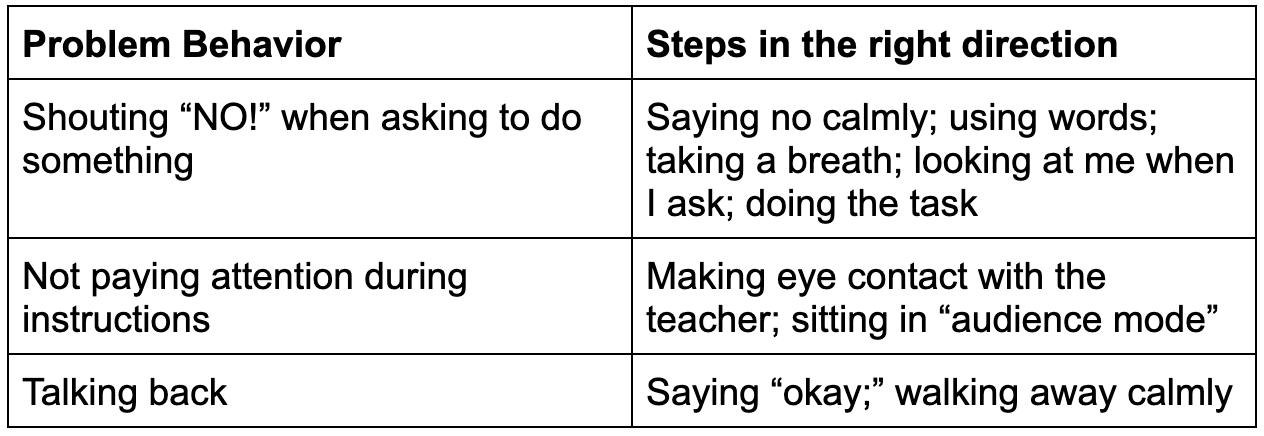
Put your chart somewhere you’ll see it regularly and aim to give descriptive praise at least 10 times a day. If you’re feeling stuck, try starting with “I notice…” and then simply describe what you see that’s even semi-positive or an improvement over the past. Now let those weeds wither and go water those roses!
The TLDR: Notice what a kid is doing well and name it using descriptive praise.